 close window  How to Glue Watercolor Paper on Canvas
|
|
Assignment: How to Glue Watercolor Paper Paintings on Canvas
Special Note: I often demo this in my workshops and later get many emails wanting the step-by-step description of my technique of gluing watercolor paper onto a canvas. I thought this was worth repeating in the ArtsyFartsy News!
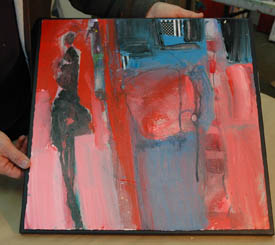
In my workshops I mostly paint with acrylic paint on watercolor paper. After a few months of teaching, I have many, many acrylic paintings on paper to frame for the galleries, festivals, etc. To save money, I figured a way to have a unique gallery presentation and get the job done fast. My thought was to glue a 19" x 19" paper paintings onto canvases. The canvas sides and the top edges were painted a color. The paper was then glued on to the canvas with a 1/2" canvas border (color) showing all around. The paper had a deckle edge all around and the end result was a totally cool “hand of the artist” presentation. Just think, canvases with watercolor paper glued on them. No frame, no mat and no glass. The gallery was delighted with the ease in hanging the canvas, no scratched frames or glass breakage AND no bothersome reflections. Now for the step by step. 1. I use 20" x 20" canvas.
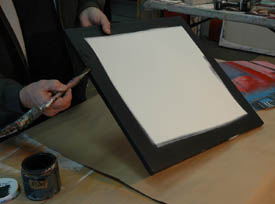
2. I choose a neutral gray color and paint the canvas sides plus an inch or two all around the canvas front. Let dry.
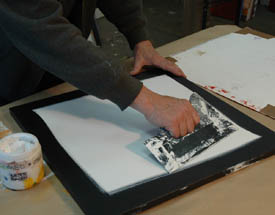
4. Using acrylic gel medium as my adhesive, I squeegee it all over the entire canvas surface and ALSO on the back of the paper painting.
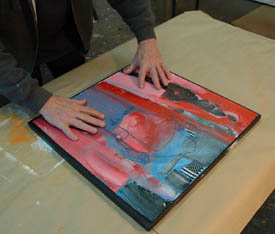
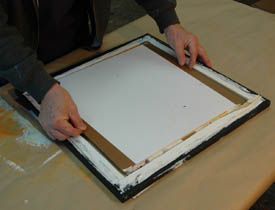
5. While both surfaces are still wet, I position and center the paper on the canvas, making sure the canvas 1/2" borders appear even all around.
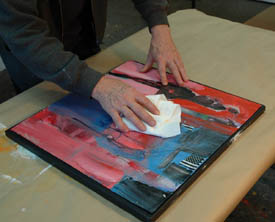
6. Using a large moist sponge or towel, work out from the center and squeeze out any air bubbles and excess gel medium, making sure the deckle edges are smoothed down as tight as possible. The exposed deckle edge gives the presentation a “crafted” look. I would never try to line up a 20" x 20" paper exactly to the canvas edges… because you can never have a perfect alignment with a flexible canvas. So I show the edge. It is what it is! I don’t try to conceal or hide the technique.
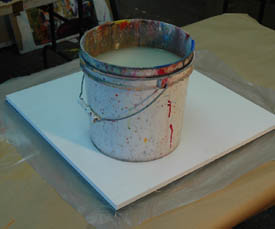
7. Under the canvas I stack foam boards between the stretcher bars to shore it up so the canvas doesn’t sag or push down in the center while mounting the paper.
8. Position a 24" x 24" plastic sheet (4 ml polyethylene) on top of the mounted painting. Next, I place a 24" x 24", 1/2" thick board on top of the plastic. Finally a weight, such as a cinder block or water bucket, goes on top of the board – to squeeze it all down. (Like pressing flowers.)
9. After 24 hours, I remove the weight, the board, the plastic slip sheet and lift the canvas off the underside stack of foam boards. The entire process results in a very strong adhesion of paper to canvas.
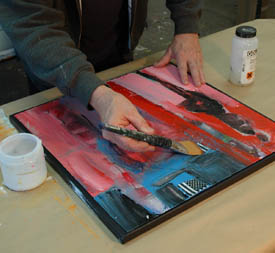
10. The final step – I brush on acrylic varnish over the entire top surface, including the canvas sides. The hanging wire is screwed into the back of the stretcher bars as usual. This may sound labor intense but the results are beautiful. It’s lightweight, no frames, no mats and no glass, and is very contemporary. You might ask, why not just paint on a canvas? As I said in the beginning, I have many, many paper pieces ready for exhibition and did not want the expense of framing every one. Hey, it’s only an idea I’ve tried and it worked! Try it out and see how you like it! |

If you wish to copy this material to other publications
or mail lists, please ask for permission by contacting:
Robert Burridge Studio
Arroyo Grande, California
805-459-1503
rburridge@robertburridge.com
www.robertburridge.com
close window